
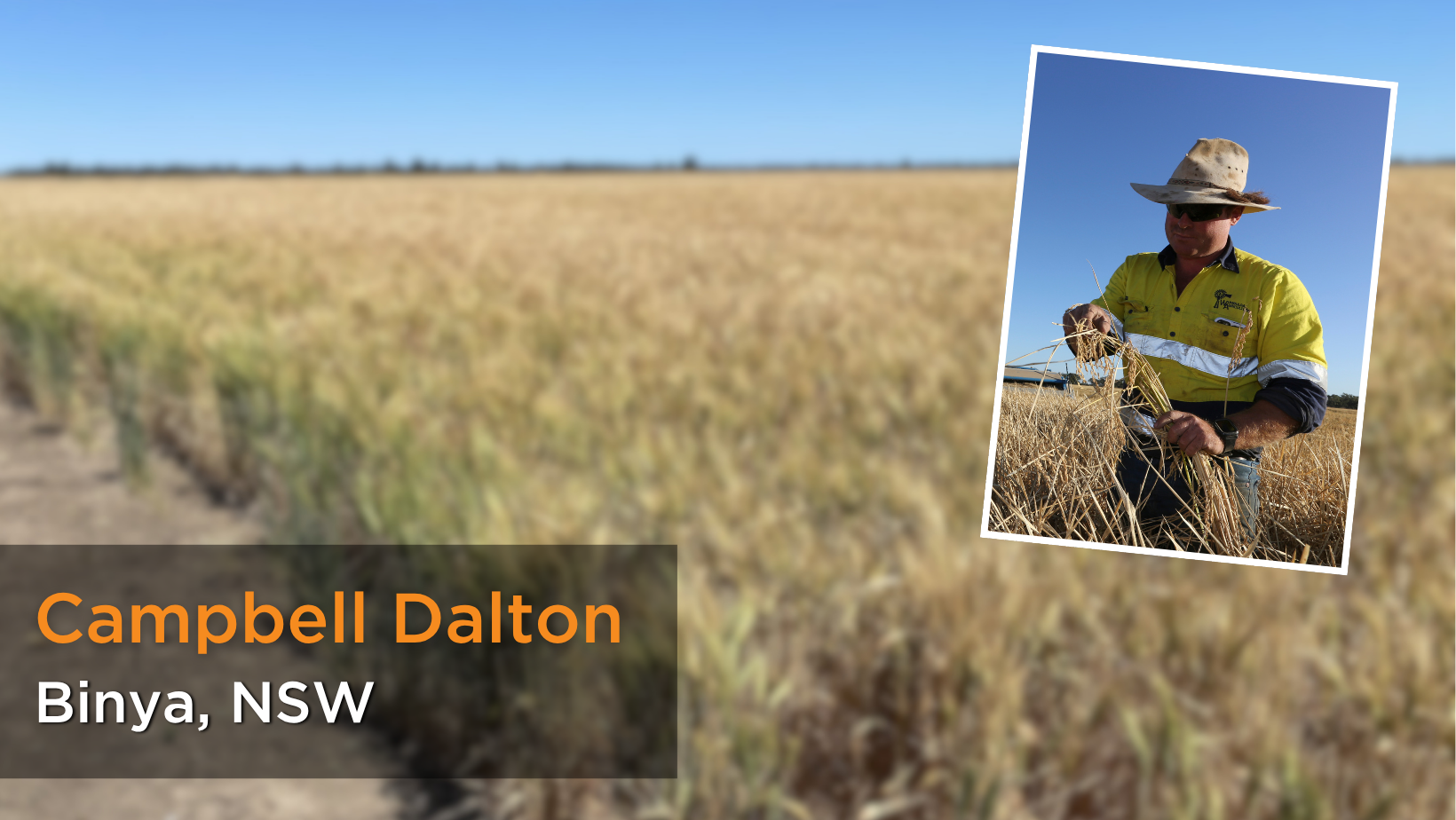
Hi. I’m Campbell Dalton, and my family and I farm across two aggregations. The first, which is where our primary business is based, is just east of Griffith in southwestern New South Wales. We also have another stock block that's about 60 kms north of Condobolin in the central west.
On our primary block, we are a mixed farming operation, with both irrigated and dryland crops. Our summer crops can consist of rice, corn, and cotton, and our winter cropping program is generally wheat, barley, and vetch on the dry land, and on the irrigated land, we do wheat, barley, seed canola, and milling oats.
At Condobolin, we have our grazing operations, with herds of cattle and a handful of sheep, and we also harvest goats when the opportunity arises.
The irrigation block at Griffith is primarily on the Mirrool Creek flood plain, and the soils range from loamy clays to fairly heavy clays. And on the dry land, it's sort of loamy clays to red loams, depending on where you are.
An honest assessment of the Condobolin block is that it is a pretty mixed bag, with some deep red sandy soils, a little bit of floodplain, and then some absolute rubbish thrown in for good measure.
In terms of water, we would average around 400mm rainfall across both blocks, with irrigation sourced from the Murrumbidgee irrigation area at Narrandera and delivered to us via a channel network.
Because the water comes through the Murray Darling Basin scheme, we need to work to ensure we are fully compliant and the rules and regulations certainly keep us – and everyone else around us – fairly busy.
Last year, for our winter cropping program, we scraped through by the skin of our teeth, and this season we are in a fairly dry patch across both blocks, so it’s not looking good. Unfortunately, there has been little rain about, and what there has been has missed us, so we are potentially looking at a below-average season for this one coming. Irrigation is also a concern, as the water is only as good as the level in the dams, which is quite low at the moment. The catchment area itself is quite dry, so it's going to take a fair bit of rain up in the mountains to actually increase the amount of water we can access. It could be a reasonably difficult 12 months to say the least, but having had a run of fairly decent years from 2020 onwards, I suppose it’s our turn to have a tough one.
At the moment we have a bit on, we have just finished our rice harvest and were lucky enough to achieve above budget yields and quality. Following harvest, we will be into seeding pastures, and we are hanging off a little and going a bit later than usual purely because of water availability. The dryland sowing program will start around early May, and by the end of the month, we should have it finished.
But again, the area that we'll put in this year will require a careful assessment of a range of factors. It’s not just subsoil moisture to consider; we also need to take into account the substantial increase in input costs. You do need to carefully consider your gross margins when making a decision, because unless we're doing sort of average or above-average crops, we will be going backwards. It is a real challenge, particularly given the current issues around fuel and fertiliser caused by the war in the Middle East.
I'm much more optimistic about the fuel situation than I am about the fertiliser. I think particularly with nitrogen, we have the potential for issues with both availability and pricing. It would be very frustrating to have the conditions to grow five-tonne/ha wheat crops and then not be able to access or afford the urea to help it reach its full potential. Anything can happen, but when our demand for urea is about 2 million tonnes, and 1.2 million of that normally comes through the now-closed Strait of Hormuz, there is a lot of pressure on that market. And we are all waiting to see what happens.
If we don’t get the moisture we need to have a fighting chance at average or above-average crops, we could consider reverting to a fallow program. Some other options would be to increase the amount of vetch or, if we get a later break, we could try field peas as a cash crop. The decisions we take will depend on the season we get. The approach we adopt is to be flexible while having a strategy and options in mind. If you do have some preconceived limits, it makes it easier to make those decisions when they come up.
Despite all the issues, I genuinely like being a farmer and producing food and fibre. I get to work with some pretty wonderful people in some pretty wonderful environments, and I've got a pretty nice office I get to come to every day. I quite honestly enjoy the land, and I think there's definitely still a certain romance in farming. There is no better buzz than harvesting a great crop and seeing all the hard work come to fruition. As a member, I am pleased to have GrainGrowers representing our interests.