
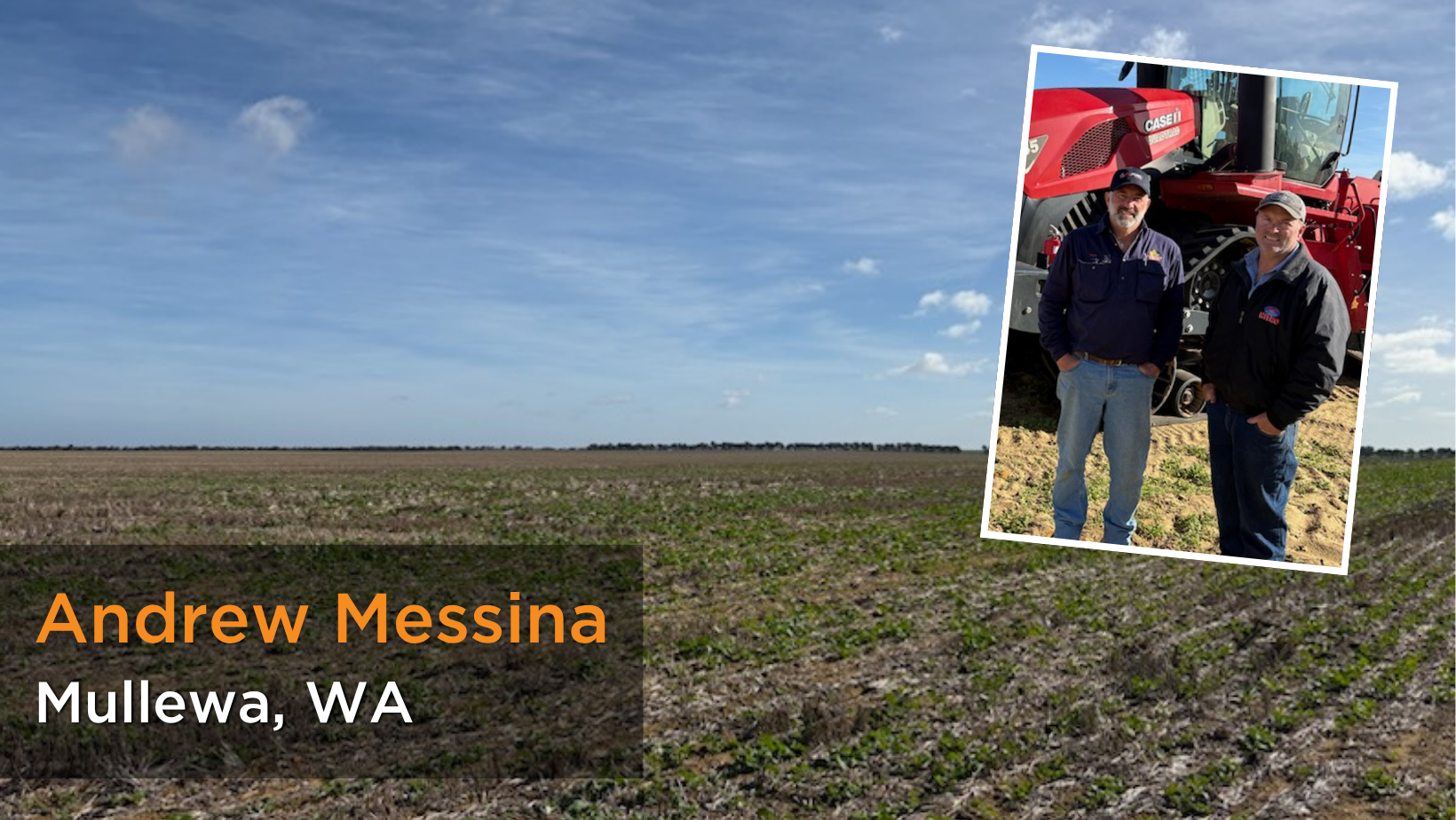
I’m Andrew Messina, based at Spring Park Farms in Mullewa, about 100 km east of Geraldton. Our properties extend roughly 50 km west and 100 km south of Mullewa towards Dongara.
I farm with my wife, Tracey, my brother Rod, and his wife, Sam, and we also employ five full-time staff.
We crop around 13,500 hectares across four properties. At the Mullewa end, which is the lower-rainfall part of the farm receiving 250 mm annually, our soils are predominantly yellow sand and red loam.
This season, like many growers in our area, we’ve had major issues with mice. We’ve been baiting as we seed, typically finishing a 2500-hectare block in a week, then baiting it as soon as the seeders come out. There are rows missing where crops have been eaten out, and the burrows are still very active, so we’re preparing to bait again. It’s the worst mouse plague I’ve seen in 30 years.
Mouse numbers are now at least double what we had seen in wheat stubble. Usually that’s where they are worst, but this year they’re in every crop—it’s another level entirely.
Aside from the mouse plague, the season has started very well. We picked up about 30 mm of rain in February and nearly 20 mm in March, double that at the Mullewa end of the farm, which was a welcome surprise.
Before seeding, we did a lot of deep ripping last December and again in February when we had some moisture.
We held off on seeding because conditions alternated between wet and dry, so we didn’t start until around 20 April. We began with some canola, then switched to wheat, which was a bit unusual for us not to go onto lupin. We sowed into dry soil rather than moisture, which meant shallow planting.
We had about 300 hectares of wheat in very early, and it established well. After more rain on 30 April, we kept going and got a significant area of wheat sown. Having it emerge that early is very unusual for us up here.
We were also well organised this year for fuel and fertiliser, which removed a major source of stress and allowed us to put our full cropping program in as planned.
Our rotations are canola, wheat, wheat, lupins, wheat and wheat. At the western end of the farm, however, we can switch from canola to lupins, which is what we’ve done this year.
We have a set start date and, if there’s no rain by 20 May—or no sign of rain—at the Mullewa end of the property, we move that country to the end of the program. We also switch to a shorter-season canola variety, or fallow.
Deep ripping has been a game-changer for us over the past 30 years. We’re now going deeper, around 600 mm to 650 mm where we can. On the red loam it’s harder, so we usually reach around 450 mm. That extra depth helps crops access moisture left over from last year, which is especially important when we don’t get finishing rain. Mouldboard ploughing 10 years ago is still giving us substantial benefits through reduced non-wetting and higher PH soils.
Another major step forward for us has been camera sprayer technology. We’ve been spraying green-on-green for six years, and it has worked very well. We were involved early with Bilberry, now Trimble, and spent the first two years doing a lot of ground-truthing. They marked out weed quadrants, GPS-located them, and followed up with each new algorithm as it came out. As a result, we can now camera-spray lupins for radish in a single pass. It’s far more cost-effective, although we still invest heavily in our pre-emergent program. We adopt new products as soon as we can, which allows us to reduce our post-emergent inputs.
Our four-leaf wheat crop is very clean, with hardly a weed in it. We’re probably only looking at one camera spray in a month’s time, which has saved us a lot over the years.
We’re now chasing one per cent improvements through more accurate seeding equipment, including liquid nitrogen down the tube. We waited a long time for the right setup because we weren’t satisfied with the equipment available on the market. We’ve been using the system for the past four years, it is more accurate, and it now gives us the flexibility to hold off on further nitrogen applications if conditions allow.
We retain stubble and also run Harrington Seed Destructors. In heavy lupin or canola crops, we still need to use windrow burning to keep things tidy.
We also use fallow when it looks like the season won’t give us the start we need. The main benefit is conserving moisture rather than growing a crop that is unlikely to be profitable.
We’ve been fortunate to have reliable supplies of fuel, fertiliser and other key inputs, so at this stage of the season we’re feeling confident.
We’ve built long-term relationships with our agronomist and industry people, who know our area well. We budget carefully each year, but ultimately, it’s about using resources more effectively.
Looking ahead, we are training our full-time staff to gradually take on more of our roles. It’s becoming harder to come up with new innovations, and new strategies so we’re working to streamline operations. We’re also developing simple template sheets for each crop program so the team can quickly access the key information.
We want to step back from day-to-day operations over time, so we’re starting to build a more formal structure. That includes developing a management team to oversee jobs and building a strong full-time workforce, which is not easy.
One of the main challenges I can see in farming, is keeping up to date with all the HR and continually refining your processes to reflect a best practice workplace.
We’re putting strategy and management systems in place, so the business doesn’t necessarily rely on any of the children returning to the farm, although if they do choose to come back, that’s great. Our biggest concern for the future is finding people who genuinely want to farm, are passionate about the work and can cope with all the challenges we deal with now. We’ve grown into those challenges and learned how to manage them, but is that realistic for the future?
There is still plenty of change ahead. I thought we would be further advanced with autonomy by now. For example, autonomous tractors could be driving our rippers, but I think insurance is one of the main barriers. When we’re ripping, we’re only travelling at about 8 km/h, so it’s a slow operation. We already have enough sensors in place and can monitor tractors from a phone, so I don’t understand why technology is not further ahead. I’m also interested in whether SwarmBot technology will become practical, especially given the size of paddocks up here. We’ve done some small trials with drones, creating a weed map and then using our sprayer to ground truth those areas, and we’ve come quite close to matching the drone data with the sprayer camera operation.
I still get a lot of satisfaction from seeing a crop emerge. You take the risk when you plant a crop, so when you come back and see a one-leaf wheat or canola plant pushing through, there is a sense of relief and excitement. I’ve always spent time on the sprayer, and the header, and out in the paddock, so watching the crop grow—and then seeing the result at harvest—is still the highlight for me.