GrainGrowers Market Update Report
The Reserve Bank of Australia (RBA) decision to hold interest rates at 4.35% this week has provided relief to farmers with debt facilities given Australia’s grains industry pays over $4.5 billion in interest a year. Interest is the 5th biggest expense for Australian cropping farms, making up 7.99% of all cash costs.
The market had largely factored in that the RBA would hold rates, and as such, the exchange rate was not moved, sitting at 70.59 cents to the US dollar compared to 70.47c/USD a week ago.
Wheat and canola prices hit two-year highs in July - the highest level since June 2024 - on the back of increased fighting on the Black Sea, and a forecast of the lowest U.S. wheat harvest since the 1970s. On 22 July the CBOT wheat futures price hit 705.75 USd/bushel. Meanwhile, a smaller than forecast European harvest caused by widespread drought conditions, which are estimated to have wiped out 9 million tonnes of production, has also supported the recent highs.
A recent upwards revision of Russian and Ukrainian wheat production by the USDA, and a general consensus that there is ample wheat supply this year - as evidenced by a large South African corn harvest - are offsetting upwards commodity movements.
At present CBOT wheat futures sit at 648.7 Usd/bushel. While down on recent highs – they are 26% up of year-ago prices.
Oil prices remain volatile this week with the Brent crude futures price at $79.45 USD/barrel. It finished the week (Wednesday 12 August) at $89.97USD/barrel - an increase of 13% across the week. The surge this week reflects uncertainty around whether a peace deal between the U.S. and Iran will be secured, and concerns regarding damage to Red Sea oil infrastructure and boats.
In the next fortnight there will be two data releases: the ABS livestock products and ALFA's feedlot survey, which will provide great insight into Australia's feed grain market.
Argus Media Fertiliser Report
Urea
Australian retailers and resellers are mostly holding off on purchasing prompt tonnes of granular urea, with buying centered around summer crop requirements from September.
Argus last assessed granular urea at A$810-840/t fca Geelong.

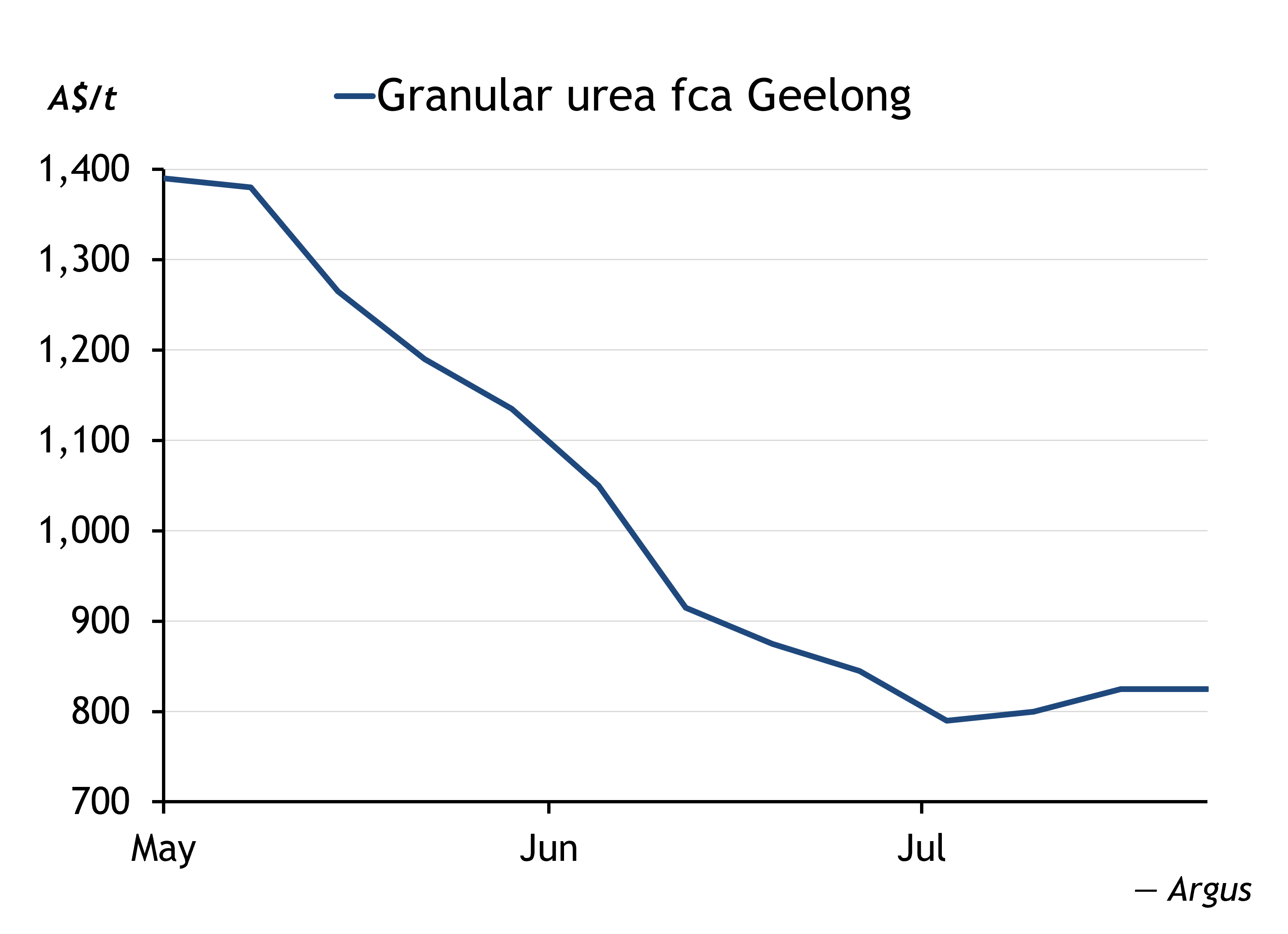
Multiple market participants reported short prompt supply but showed little concern because of the slower domestic demand. There are three vessels in transit to Australia carrying a combined 100,000t from Southeast Asia, vessel tracking data from Kpler show.
Australia’s urea imports fell by 9% on the year to 1.09 million tonnes in January-June, trade data from the Australian Bureau of Statistics (ABS) show. Imports from Southeast Asia jumped by 55% while those from the Middle East fell by 64%, reflecting the change in trade flows following the outbreak of war in late February, ABS data shows.
Phosphates
The domestic phosphate market remains unchanged, with only small pockets of demand heard for MAP. There is some interest in forward buying MAP/DAP to meet winter crop requirements for pick-up in 2027, importers said.
Australia’s MAP imports fell by 18% on the year to 834,000 tonnes in January-June, ABS data shows. Supply from China dropped by 98% and this was only partially offset by increased imports from the US and Saudi Arabia, ABS data shows.
Fertiliser commentary and pricing supplied by Argus Media
Disclaimer: The information provided in this report is general in nature and is intended for informational purposes only.